

Didact (noun): A didactic person.
Didactic (adjective): designed or intended to teach — or — intended to convey instruction and information in addition to serving another purpose (such as pleasure and entertainment)
My dad, Don Choate, loved to teach. He was an undiagnosed dyslexic and probably had some form of ADHD. He grew up in the 1940-50’s when the world didn’t have terms for the way his brain functioned. As such, he had a special relationship with a pair of teachers who stepped in and help him finish high school. Determined to stay out of the military, he completed college, then was pulled into Vietnam in spite of his degree. Upon his return, he enrolled in a master’s program in teaching and spent most of the rest of his teaching career as an industrial arts teacher in junior high (grades 6-8.)
The unfortunate part of this story is that while Dad loved to teach, he was temperamentally unsuitable for a life dealing with the petty politics of public school. Within ten years, he was burned out. He stayed for almost thirty years, the last ten (I believe) marking time as a remedial math teacher.
The hazards of teaching made an impression on me. Temperamentally similar to Dad, I decided early on that teaching would not be my vocation. I truly believe this has been one of my better life choices.
Which is why I may need to reconsider my recent attempts at teaching art classes.
In back of the Pacific Artists’ Gallery is a large classroom run by the Artists’ Studio Association. It’s a great space, and I’ve been puzzled by how often the space is empty. I’ll gloss over why I made this decision, but I talked myself into teaching a few classes.
In October I taught Experiments and Expression in Liquid Charcoal. I had taught a version of this class a few years ago at the Watercolor Society of Oregon, so I felt reasonably confident. The class went well. At the very least, no one threw anything.
Based on what I saw in this class, I thought a class on working in a series as a way to make paintings more personal might be well received. I designed a course to be taught once-a-month over three months. My thought was I could help participants work in a series as a tool for learning about their painting style.
Class 1 – Color
For the first class, I focused on color. I felt like it was an easy entry into the subject of makings paintings more personal.
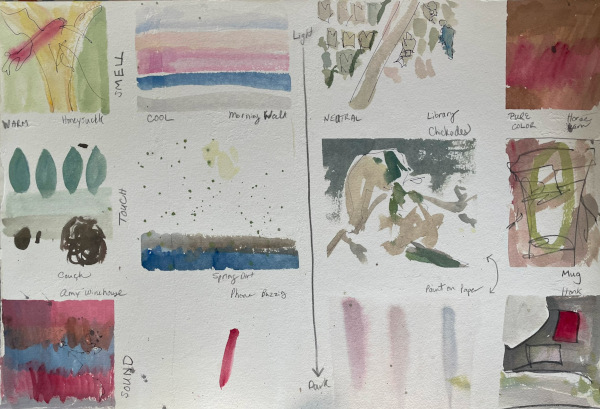
After a short lecture, the first exercise was a map of color emotions. The idea, from a Ruth Armitage workshop, is to create a grid with warm/cool/neutral/pure columns and light/medium/dark rows. Then assign a smell, touch, or sound to each square.
From there, we worked in straight color theory. I assigned a simple composition in three different color schemes (analogous, complementary, tetradic, etc.)
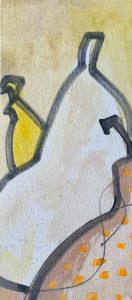
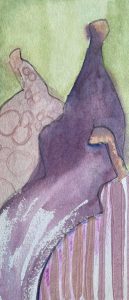
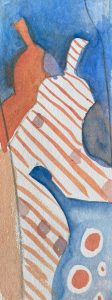
Finally, we worked through a worksheet I had adapted from a Ruth Ellen Hoag workshop. The worksheet was for the artists to gather their ideas about what they might work on, writing down the moods, emotions, and feelings they were trying to invoke. Then, using that exercise, go home and work on a least two paintings in the series they had selected.
Homework (mine)
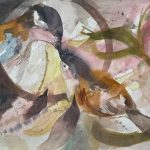
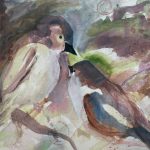
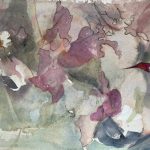
These are three paintings I did based on the third column, second row color map (above) I did.
Class 2 – Personal Symbols and Mark Making
I know enough about humans to not be terribly shocked when the next class came around and none of my students had embraced the homework. While some of them did a couple paintings, no one really went above and beyond a few tentative attempts.
I didn’t let it get me down. After a short lecture on using symbols within paintings, I assigned a warm up to get the class moving, then played a video on asemic writing. This is where things kind of went off the rails. The idea is to practice making random scribbles that look like writing, but aren’t. Then, you look for shapes in those squiggles and develop those shapes. Here is what I did during this exercise.
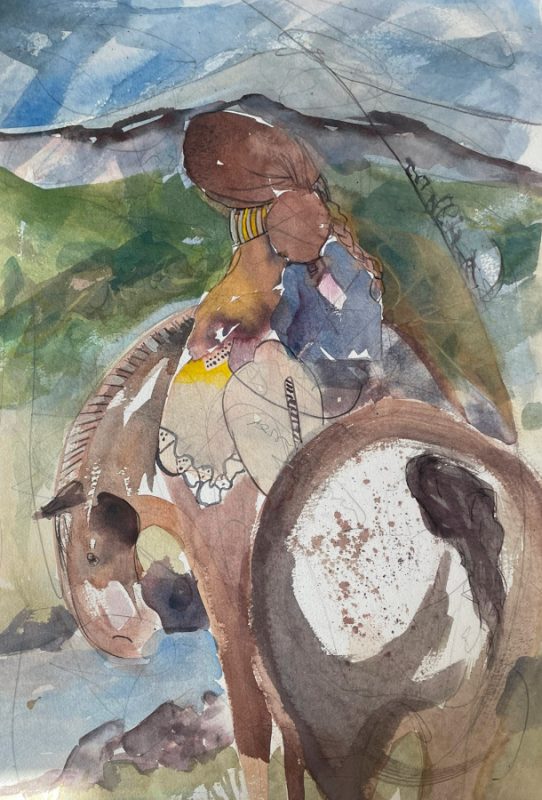
The class didn’t get it. At all. Looking back at it, it’s clear that I over faced them. As a group they were used to trying to paint things. Being asked to make up a composition was just too much. A couple students, in particular, did NOT get it. I ended up moving the class along to the final exercise.
This idea was developed from a children’s art video by Courtney Rock that had been inspired by Uruguayan artist Joaquin Torres-Garcia. The artists divided their sheet of paper into twelve irregular rectangle and drew a symbol representing themselves in each space. Letter, numbers, pets. It’s all symbols. Then to pick a three-color complementary color scheme to fill in the painting.
Things got better, but the essential message of what I was hoping to teach was utterly lost. Paint. Apply paint. Paint some more. Ruin some paper. Paint.
Finally, we reviewed the pieces the group had done, that day and over the last month, and I encouraged them. I said over and over, “This is great. Now do twelve more.” The looks were baffled.
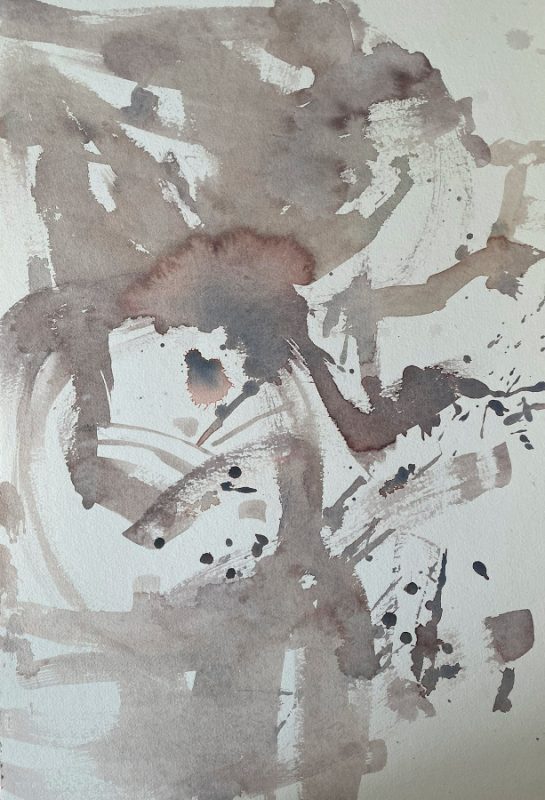
Trying to get the group to see that applying paint is fun, I cleaned my palette and poured this. I plan to develop it by the next class.
Summary
For my final class I plan to focus on composition. I think this topic should have been my second class. The group had not yet been introduced to the idea of moving things around the paper just because they think it will look better.
But I remain startled how resistant the class was to spreading out into unknown territory. Obviously, everyone moves at their pace, but if you can’t take a chance in a workshop… where can you?